How to Call a US Toll-Free Number From Abroad
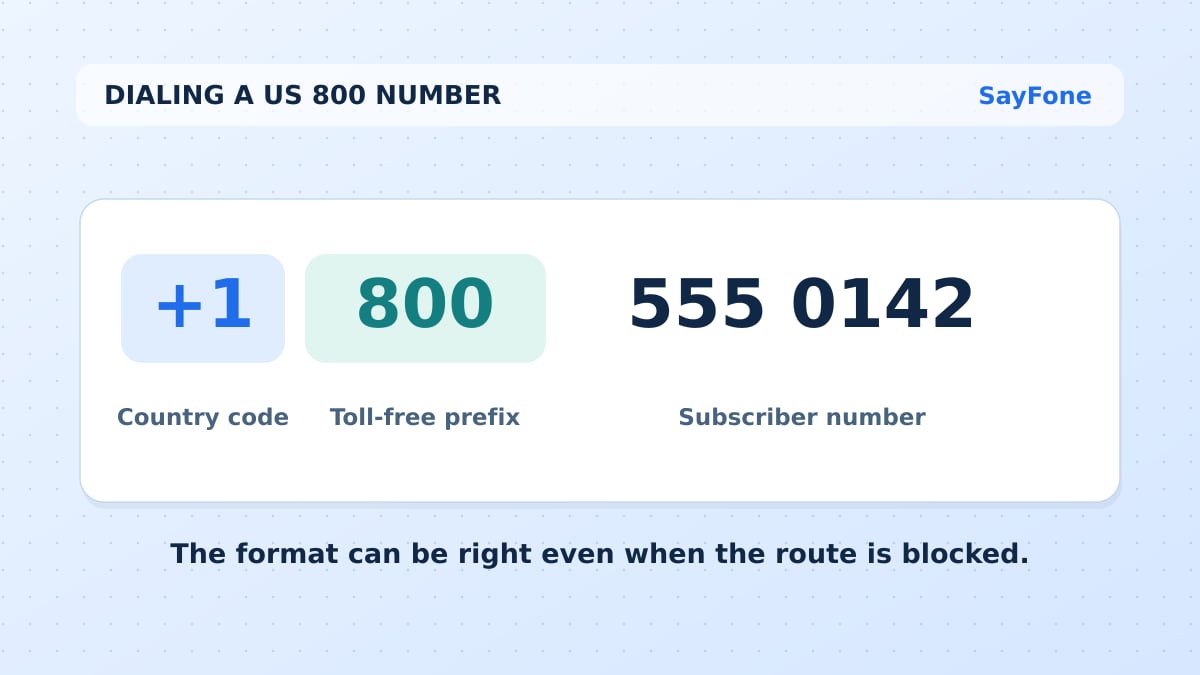
To try calling a US toll-free number from abroad, dial +1, the toll-free prefix such as 800, and the remaining seven digits. If the number accepts calls from your network, it may connect. Your carrier or calling service can charge for the international route. If the call fails, look for the company's published number for overseas callers.
This often comes up with US banks, airlines and stores. A domestic support number can work when someone calls it from the US and fail from a mobile network in India, Germany or the UK. The dialing format, the network sending the call, and the company's routing rules all matter.
Dial the original toll-free number in international format
On a mobile phone, hold 0 until the plus sign appears. A number written as 1-800-XXX-XXXX becomes +1 800 XXX XXXX. The same format applies to the other North American toll-free prefixes 833, 844, 855, 866, 877 and 888. Each prefix is part of the number, so keep the one the company published. The FCC's guide to toll-free numbers lists the codes.
From a fixed line without a plus key, use the international access prefix required by the network you are dialing from, followed by 1 and the ten-digit number. On a hotel phone, check whether you also need a digit to reach an outside line. If you are in India, a mobile call can use the +1 format without typing the local access prefix. See the guide to calling the United States from India for regular US numbers.
If a voice message says the call cannot be completed from your area, redialing the same digits often yields the same result. Check whether the service accepts international calls before trying another network.
Why a US 800 number can fail abroad
Toll-free pricing applies within the calling area supported by the number and network. The owner can limit where calls come from, and some carriers do not route an overseas call to that toll-free range. A number can therefore work from one network and fail from another. If it connects, check what the provider charges before staying in a long queue.
An app or browser service may route the call differently from your local carrier. Check whether it supports that specific toll-free prefix and origin. The published price for an ordinary US landline may differ from the price or availability of a toll-free number. A US caller ID on its own gives no guarantee that a geographically restricted call will connect.
Is +1 800 the same as +800?
+1 800 starts with the North American country code +1, followed by the 800 toll-free prefix and seven digits. +800 is a separate global service code with eight digits after it. You may see a Universal International Freephone Number written with an access prefix, such as 00 800 followed by eight digits. Its availability still depends on participating networks. See the ITU's explanation of the international +800 format.
Use the number as published. Replacing 800 with 888, dropping the country code, or adding an extra 0 changes where the call is sent.
What to try when 1-800 does not connect
Look for the company's international support number. Go through the company's app or contact page and look for “outside the US,” “international,” or the country where you are calling from. For an airline, the local office can be more useful than the US reservations line. Check office hours in its local time zone.
Use a published regular number. If the company gives you an ordinary US area code, try +1 followed by its ten digits. Check the US calling rate for that number type and use a supported phone service. A browser call over Wi-Fi or a travel eSIM can reach an ordinary phone number if the calling service supports the route. See how to place a call with a data-only eSIM.
Follow the bank's collect-call instructions if it offers them. Some institutions publish a separate number for calls from outside the US and ask you to place an international collect call through a local operator. Confirm the process for your specific card or account through the bank's official site or app. For an example, see Bank of America's international contact options. A normal paid call to a number listed for collect calls may be billed differently, so check first.
Use a secure message or callback if available. The official app or website may offer chat, a secure message, or a callback to a number you can receive abroad. If you are trying to verify your identity, use the company's own contact page or the number on your card. Avoid numbers copied from search ads or unsolicited messages.
A quick example from overseas
Suppose you are in Bengaluru and the US hotel you booked lists a 1-800 reservations line. Try the full +1 800 format once on a service that supports it. If you hear a routing error, open the hotel's own contact page and look for the front desk's regular local number. Dial that number as +1 plus ten digits. Have your reservation details ready and ask the front desk to transfer you if needed.
For other destinations and regular phone numbers, use the SayFone call rates directory to check the country and route before calling.