International Calls VoIP Providers: Costs and Features Compared
For occasional international calls to ordinary numbers, SayFone is our recommended VoIP provider when you want to call directly from a browser. If you need shared business numbers, messaging, call routing and several staff accounts, compare a business phone system separately. Those are different purchases with different recurring costs.
“International calls VoIP providers” covers services that sell a few outbound calls and systems that replace a company's telephone setup. The useful comparison starts with who makes the calls, where the calls go and whether anyone must answer an incoming call on the same number.
International calls VoIP providers compared
| Provider | Purchase model checked | Best fit in this comparison | Limit or extra cost to inspect |
|---|---|---|---|
| SayFone | Prepaid destination-based calling | Our pick for individual browser calls to normal numbers | Incoming numbers are separate products |
| Viber Out | World Credit and destination plans | Callers comparing app-based credit and country bundles | Exact destination and number-type inclusion |
| Rebtel | Credit and destination offers | Callers who want to compare its local-line methods | Availability and local-carrier access cost |
| Google Voice for Workspace | Starter listed at $10/user/month | An organization already comparing Workspace phone service | Workspace requirement and international charges |
| Quo | Starter $19/user/month on monthly billing | Teams wanting a business number and messaging | International destinations and extra usage charges |
Sources checked 11 November 2026: SayFone, Viber Out, Rebtel, Google Voice and Quo pricing. Business-seat prices do not imply unlimited international calls. Google lists several subscription types; the row refers specifically to the Workspace Starter option.
Why we would choose SayFone for individual calls
SayFone lets the caller use an internet-connected browser to reach a supported ordinary phone number. It suits a traveler calling a hotel, a person contacting an overseas office or someone whose relative uses a landline. The recipient answers their regular phone.
You can begin with prepaid credit without buying a team seat or monthly number. If you want a recurring budget, monthly calling credit adds $20 of credit for a $20 payment after successful renewal. That is a funding schedule, not an unlimited-minute promise.
We favor this setup when the job is simply to make calls. We would not tell a support team to buy outbound credit and assume it provides a shared inbox, incoming queue or SMS workflow. Those requirements belong in the product comparison from the start.
Compare the same destinations and number types
Choose three or four real contacts and compare their routes. Include the countries, mobile or landline status and the amount of calling you expect. A provider with a low rate to one destination can have a higher rate to another.
At the public SayFone rates checked on 11 November 2026, a ten-minute call at the displayed $0.08 rate works out to $0.80. At $0.44 it works out to $4.40. That difference is why a general “international minutes” label is not enough for a budget. Recheck the actual destination and supported number before dialing.
Ask how providers bill partial minutes, whether there is a connection charge, and what happens to unused credit. For subscriptions, inspect excluded routes and any fair-use conditions. Use the total expected monthly bill rather than a single headline rate.
Business seat costs can dominate light calling
Quo's checked monthly Starter price was $19 per user. Five users would therefore mean a $95 monthly seat charge before any international extras. That arithmetic is useful when comparing the purchase model, but it does not say the products offer the same features.
Google's Workspace Voice Starter row lists $10 per user per month and directs organizations to the required Workspace setup. Include the cost of the surrounding subscription when it applies to your organization. Do not mix a standalone consumer option, a Workspace add-on and a temporary promotion into one price comparison.
Those systems can be worth paying for when the team needs their number, messaging and administration features. For one person making a few overseas calls, SayFone's prepaid approach is our first recommendation because a business-seat purchase may solve a larger problem than they have.
Outgoing caller ID and incoming calls
A dedicated SayFone US number supplies an outbound caller ID in the browser dialer. The selected number has a monthly price and calls use separate credit. That product should not be advertised as an incoming phone line or SMS inbox.
SayFone's US forwarding product is separate: $19 per month, one verified US or Canadian mobile destination, ten forwarding attempts per UTC day and up to five minutes per call. If the team needs longer incoming calls, several agents or another destination country, compare a service that supports those needs.
Test the connection and workflow
Before moving important calls, test the browser, microphone and headset on the connection you will actually use. Check two-way audio, number format and any phone-menu steps. A successful call on home Wi-Fi does not prove that a hotel network will behave the same way.
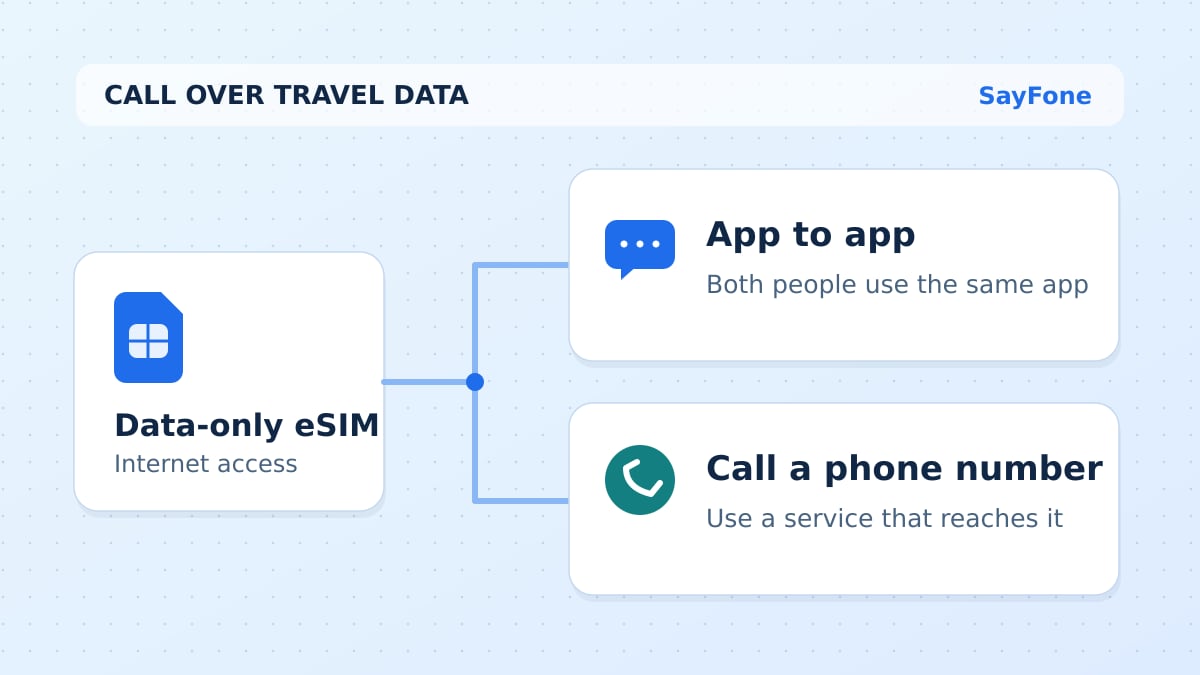
For app-to-app conversations, a meeting or messaging service may already cover the need. For calls to an airline, office or landline, you need phone-network calling support. Keep those categories separate when you compare “free calls” with paid VoIP minutes.
Our choice is SayFone for individual outbound browser calling. Use the current rates to price your routes, and use the business number guide when the requirement includes receiving calls or working as a team.